Mailing List


Amber Husain

Amber Husain is a writer, academic and publisher. She is currently a managing editor and research fellow at Afterall, Central Saint Martins. Her essays and criticism appear or are forthcoming in 3AM, The Believer, London Review of Books, LA Review of Books, Radical Philosophy and elsewhere. She is the author of Replace Me, to be published by Peninsula Press in November 2021.
Articles Available Online


Slouching Towards Death

Book Review

July 2021

Amber Husain

Book Review

July 2021

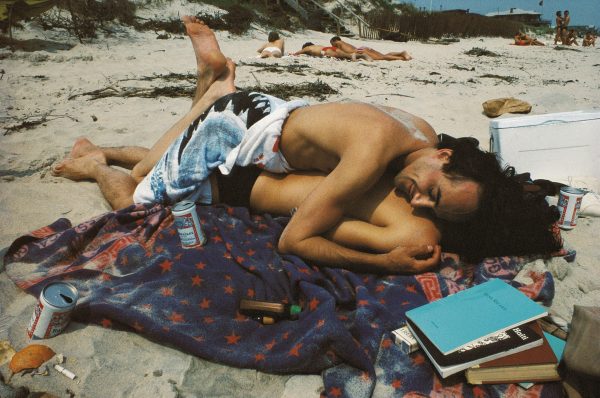
In January, a preview excerpt in The New Yorker of Rachel Kushner’s essay collection The Hard Crowd (2021) warned us that this might turn...

Book Review

August 2020

Natasha Stagg’s ‘Sleeveless’

Amber Husain

Book Review

August 2020

‘The thong is centimetres closer to areas of arousal,’ writes Natasha Stagg in Sleeveless: Fashion, Image, Media, New York,...

A collection of workers’ shirts, mounted like shopping displays and gathered into the regimented, brightly coloured rows that might mark a labour demonstration, stands as the centrepiece of Jonathas de Andrade’s solo exhibition One to One (2019), at the Museum of Contemporary Art, Chicago (MCA) The shirts are men’s Paint daubs and sweat stains trail across them, and the work, Suar a camisa (Working up a sweat) (2014), captures much of the dense, reticent logic of de Andrade’s art   De Andrade acquired the shirts from male workers in the streets of Recife and the countryside of Brazil’s Nordeste, his home city and region, and a cohering local force in his art He would approach workers on their off hours, as they travelled to work or commuted home, clearly attracted by the shirts’ vividness, their lambent yellows or soiled oranges, as well as their ability to signify – they appear worn, sturdy, industrial, as if they’ve just emerged from under the hood of a car Striking up conversations with the men, he would begin a line of inquiry: could he buy their shirt, or propose a deal, or – the preferred option – exchange his own for theirs? It’s hard to imagine the exchange coming to fruition, and yet the process resulted in de Andrade receiving 120 shirts, hung on poles and assembled in the centre of MCA’s gallery, a crowd of hollow figures   The work unfolds in layers, and my first impression was of a kind of startling political presence, as if 120 working men stood at the centre of MCA Here, it seemed, was a sincere and wishful image of the working class, its labour expressed through the sweat-marks and enlivened into the collective form of a workers’ protest But as I circled the installation, a contradictory possibility soon shadowed my optimistic impression as presence gave way to a more definitive sense of absence Not a popular uprising but shirts without bodies, dead labour rather than labour, adding up not to working-class potency but its waning or disorganisation This feeling was made more potent by the recent election of Jair Bolsonaro,

Contributor

November 2018

Amber Husain

Contributor

November 2018

Amber Husain is a writer, academic and publisher. She is currently a managing editor and research fellow at Afterall,...

On Having No Skin: Nan Goldin’s Sirens

Art Review

January 2020

Amber Husain

Art Review

January 2020

The feeling of drug-induced euphoria could be strips of gauze between beautiful fingers. Or a silver slinky sent down a torso by its own...
In Defence of Dead Women

Essay

November 2018

Amber Husain

Essay

November 2018

The memorial for the artist was as inconclusive as her work, or anybody’s life. Organised haphazardly on Facebook by one of her old friends,...

READ NEXT

fiction

March 2015

House Proud

Amelia Gray

fiction

March 2015

It’s harder to leave your burning home after you’ve spent so much time cleaning its floors. Watching those baseboards...

feature

March 2014

Burroughs in London

Heathcote Williams

feature

March 2014

I first met William Burroughs in 1963. I was working for a now defunct literary magazine called Transatlantic Review...

Art

May 2011

Twelve Installations

Lawrence Lek

Art

May 2011

These installations express the transience of our sensory world, the impermanence of form, and the artificiality of our environment....


Get our newsletter


* indicates required